The Modern University Must Become a Platform for Economic Mobility
Higher education has always carried a promise larger than the credential itself. At its best, it expands opportunity, strengthens communities, advances knowledge, and gives individuals the capacity to change the trajectory of their lives.
Yet the modern university now faces a defining question: are we still organized to deliver that promise at the speed, scale, and complexity today’s learners require?
The answer cannot be assumed. It must be proven.
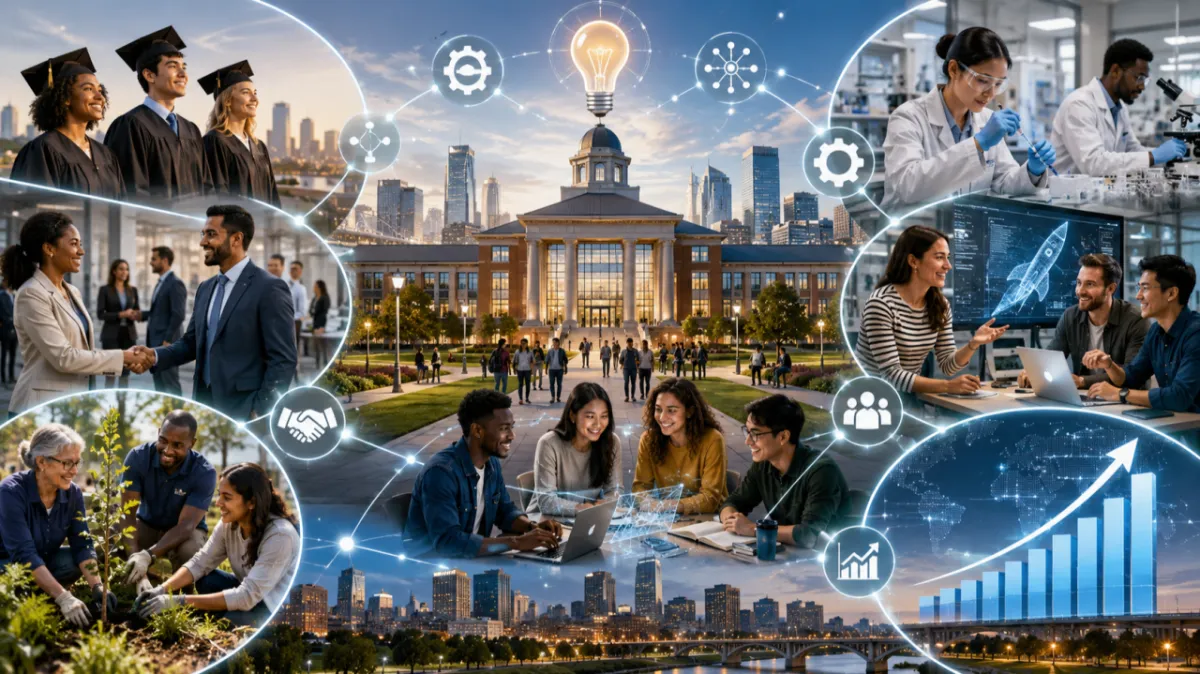
For decades, colleges and universities have been described primarily as places where students earn degrees. That description is no longer sufficient. The modern university must become a platform for economic mobility: an integrated ecosystem that connects learning, credentials, career advancement, employer partnerships, applied experience, student support, and lifelong education.
This shift matters because the value of higher education remains significant, but uneven. National data continue to show that educational attainment is associated with higher earnings and lower unemployment. The Bureau of Labor Statistics reported that workers with higher levels of education generally experienced stronger earnings and lower unemployment in 2024 [1]. Georgetown University’s Center on Education and the Workforce has also shown that bachelor’s degree holders earn substantially more over their lifetimes than workers with only a high school diploma, while warning that outcomes vary meaningfully by field, credential, and pathway [2].
That nuance is critical. Higher education still matters, but not all pathways create the same level of mobility. Access without completion is not mobility. Completion without market relevance is not mobility. A credential without confidence, direction, or career conversion is not mobility.
This is why universities must redesign themselves around the full learner journey.
First, academic portfolios must become more adaptive. Degrees remain essential, but they should be complemented by certificates, microcredentials, prior learning assessment, applied projects, apprenticeships, and continuing education. Learners increasingly need multiple entry points and multiple return points throughout their lives. The traditional model of education as a one-time experience before full-time work does not reflect the modern economy.
Second, universities must build stronger connections between academic learning and economic opportunity. That does not mean reducing higher education to workforce training. It means taking seriously the responsibility to help learners translate knowledge into agency, career mobility, and social contribution. Students need intellectual depth, but they also need durable skills: communication, ethical reasoning, technical fluency, analytical judgment, adaptability, and leadership.
Third, student support must be understood as infrastructure for mobility. Many learners are balancing work, family, financial pressure, military service, caregiving, and complex life circumstances. The Gallup-Lumina State of Higher Education work has repeatedly shown that cost, stress, and competing responsibilities remain major barriers for adults considering or continuing education [3]. If universities want to improve mobility, they must design systems that help students persist, not systems that merely admit them.
Fourth, universities must become conveners of regional and national talent ecosystems. Employers, government agencies, school systems, community colleges, nonprofits, and universities should not operate as disconnected actors. Economic mobility requires partnerships that create clear pathways from learning to opportunity. This includes experiential learning, cyber clinics, employer-informed curriculum, industry-recognized credentials, internships, research partnerships, and community-based problem solving.
Finally, universities must measure what matters. Enrollment matters, but it is not enough. Completion matters, but it is not enough. Institutions must examine whether their programs help learners advance economically, transition careers, build resilience, and participate meaningfully in society. Opportunity Insights has shown through its work on mobility that place, institutional access, and opportunity structures shape long-term outcomes [4]. Universities must see themselves as part of that broader mobility architecture.
The modern university cannot be passive in this environment. It must be intentional, adaptive, and accountable.
If higher education is to retain public trust, it must demonstrate that it can help learners move from aspiration to achievement, from knowledge to capability, and from access to advancement.
The future of higher education will not belong to institutions that simply offer programs. It will belong to institutions that build platforms for human potential.
That is the work ahead.
Sources
[1] Bureau of Labor Statistics. (2025). Education pays, 2024. https://www.bls.gov/careeroutlook/2025/data-on-display/education-pays.htm
[2] Georgetown University Center on Education and the Workforce. (2021). The College Payoff: More Education Does Not Always Mean More Earnings. https://cew.georgetown.edu/cew-reports/collegepayoff2021/
[3] Lumina Foundation. (2025). The State of Higher Education 2025. https://www.luminafoundation.org/resource/the-state-of-higher-education-2025/
[4] Opportunity Insights. (n.d.). Data library: Education, colleges, income, and intergenerational mobility. https://opportunityinsights.org/data/