Human Factors Engineering and AI Buy-In Among College Faculty
“AI buy-in requires more than demonstrating what the technology can do.” - Dr. Calvin Nobles
Artificial intelligence is rapidly reshaping higher education, but successful adoption will depend less on the technology itself and more on how well institutions understand the people expected to use it. For college faculty, AI buy-in is not simply a matter of access, training, or policy compliance. It is a human factors engineering challenge.
Human factors engineering focuses on designing systems that align with human capabilities, limitations, workflows, motivations, and decision-making patterns. When applied to AI adoption in higher education, this discipline asks a critical question: How can AI tools be designed, introduced, and governed in ways that support faculty rather than burden them?
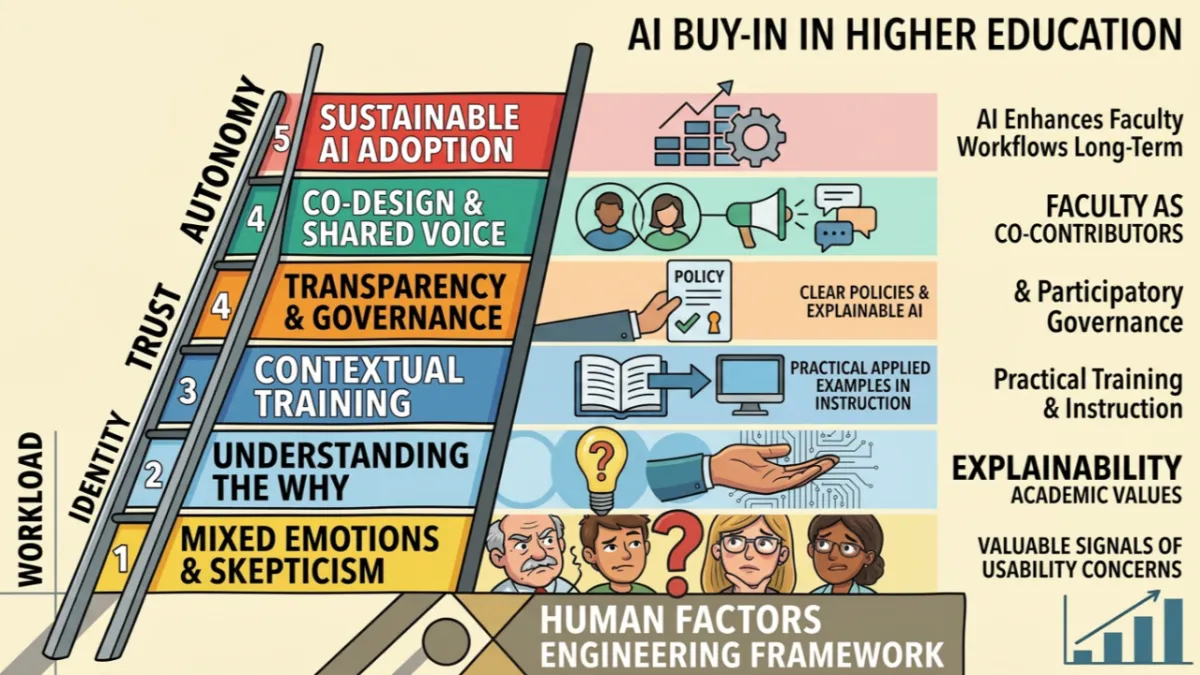
Faculty members often approach AI with mixed emotions. Some see it as a powerful tool for course design, research support, student engagement, and administrative efficiency. Others view it as a threat to academic integrity, disciplinary rigor, instructional identity, and professional autonomy. These concerns are not signs of resistance alone. They are valuable signals about usability, trust, workload, transparency, and institutional readiness.
AI buy-in requires more than demonstrating what the technology can do. Faculty need to understand why the tool matters, how it enhances teaching and learning, what risks are being managed, and where human judgment remains essential. A human factors approach recognizes that adoption increases when systems are intuitive, explainable, reliable, and aligned with existing academic practices.
Institutions should avoid treating AI implementation as a top-down technical rollout. Instead, they should engage faculty as co-designers. Faculty should help shape AI use cases, evaluate tool effectiveness, identify discipline-specific concerns, and define appropriate boundaries for student use. This participatory approach strengthens trust because faculty are not merely recipients of change. They become contributors to the design of responsible AI integration.
Training is also essential, but it must be practical and contextual. Faculty do not need generic AI overviews alone. They need applied examples connected to grading, feedback, assessment design, research workflows, tutoring support, accessibility, and academic integrity. When training reflects real instructional tasks, AI becomes less abstract and more professionally relevant.
Transparency is another core factor. Faculty are more likely to adopt AI when they understand how tools work, what data they use, what limitations exist, and how errors or biases may appear. Clear governance policies can also reduce uncertainty by explaining acceptable use, privacy protections, accountability structures, and expectations for human oversight.
Ultimately, AI buy-in among college faculty is not achieved through persuasion alone. It is achieved through thoughtful design, shared governance, trust-building, and alignment with academic values. Human factors engineering offers a practical framework for making AI adoption more humane, usable, and sustainable.
The future of AI in higher education will not be determined only by technical sophistication. It will be determined by whether institutions design AI systems around the faculty who must interpret, govern, and apply them in service of student learning.
Artificial intelligence is rapidly reshaping higher education, but successful adoption will depend less on the technology itself and more on how well institutions understand the people expected to use it. For college faculty, AI buy-in is not simply a matter of access, training, or policy compliance. It is a human factors engineering challenge.
Human factors engineering focuses on designing systems that align with human capabilities, limitations, workflows, motivations, and decision-making patterns. When applied to AI adoption in higher education, this discipline asks a critical question: How can AI tools be designed, introduced, and governed in ways that support faculty rather than burden them?
Faculty members often approach AI with mixed emotions. Some see it as a powerful tool for course design, research support, student engagement, and administrative efficiency. Others view it as a threat to academic integrity, disciplinary rigor, instructional identity, and professional autonomy. These concerns are not signs of resistance alone. They are valuable signals about usability, trust, workload, transparency, and institutional readiness.
AI buy-in requires more than demonstrating what the technology can do. Faculty need to understand why the tool matters, how it enhances teaching and learning, what risks it manages, and where human judgment remains essential. A human factors approach recognizes that adoption increases when systems are intuitive, explainable, reliable, and aligned with existing academic practices.
Institutions should avoid treating AI implementation as a top-down technical rollout. Instead, they should engage faculty as co-designers. Faculty should help shape AI use cases, evaluate tool effectiveness, identify discipline-specific concerns, and define appropriate boundaries for student use. This participatory approach strengthens trust because faculty are not merely recipients of change. They become contributors to the design of responsible AI integration.
Training is also essential, but it must be practical and contextual. Faculty do not need generic AI overviews alone. They need applied examples connected to grading, feedback, assessment design, research workflows, tutoring support, accessibility, and academic integrity. When training reflects real instructional tasks, AI becomes less abstract and more professionally relevant.
Transparency is another core factor. Faculty are more likely to adopt AI when they understand how tools work, what data they use, what limitations exist, and how errors or biases may appear. Clear governance policies can also reduce uncertainty by explaining acceptable use, privacy protections, accountability structures, and expectations for human oversight.
Ultimately, AI buy-in among college faculty is not achieved solely through persuasion. It is achieved through thoughtful design, shared governance, trust-building, and alignment with academic values. Human factors engineering offers a practical framework for making AI adoption more humane, usable, and sustainable.
The future of AI in higher education will not be determined only by technical sophistication. It will be determined by whether institutions design AI systems around the faculty who must interpret, govern, and apply them in the service of student learning.