AI Disruption Is Higher Education’s Call to Do Better
This morning, I read the Chronicle of Higher Education article, “Another Undergrad Is Trying to Disrupt College With AI. He Says His Version Is Not Cheating.” It raises an important question for higher education. Are colleges and universities responding to AI disruption with enough imagination, urgency, and institutional courage?
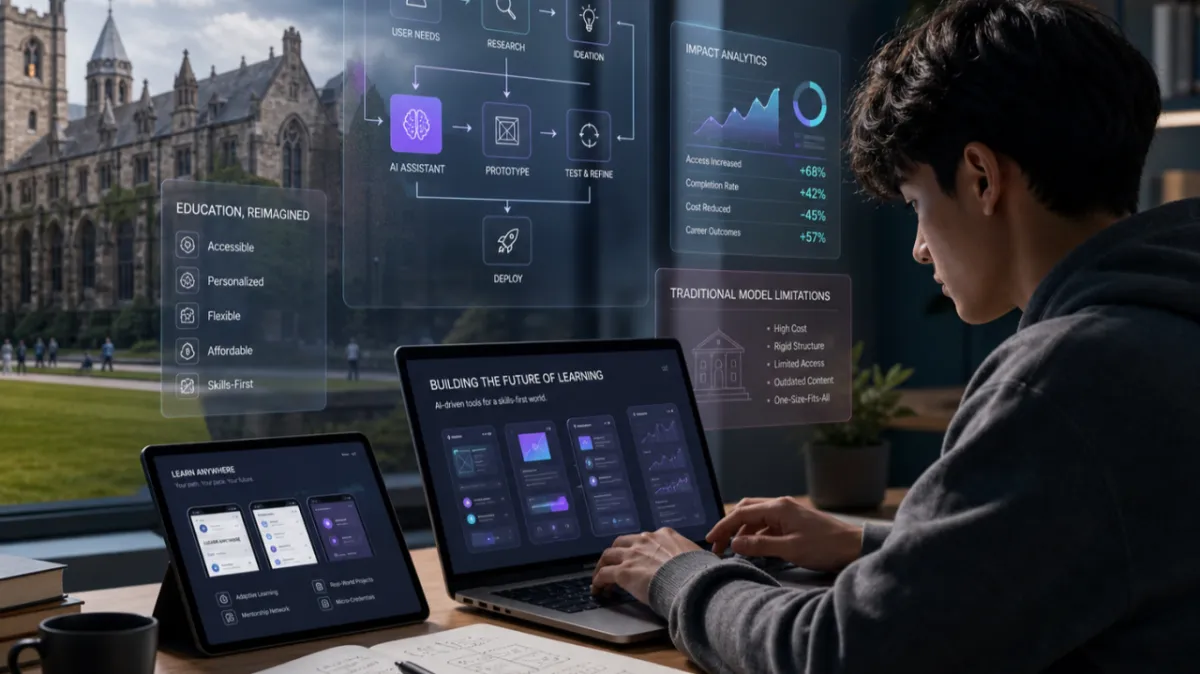
The article describes Kerra, a student-created AI tool presented as a productivity platform rather than a cheating mechanism. It connects with Canvas, reads assignments, grades, and uploaded materials, then helps students create study guides, organize notes, track deadlines, receive reminders, and draft assignment-related content. Regardless of how one views the tool, it signals that AI is moving directly into the learning workflow.
Let me be clear. Cheating is never the right thing to do. Academic integrity matters. Students should not use AI to misrepresent their work, bypass learning, or outsource the intellectual effort central to their education.
At the same time, these disruptions are not isolated events. They are signals. Students are building and using AI tools faster than many institutions can fully understand, govern, or integrate them. That reality should challenge higher education to do better.
If assignments can be completed with minimal student engagement through a tool, we must ask whether those assignments still measure the learning we value most. We need clearer AI policies, stronger student guidance, better faculty support, and assessments that measure judgment, creativity, application, reflection, ethical reasoning, and problem-solving.
The real opportunity is not to preserve the status quo. The opportunity is to enhance it.
AI is forcing higher education to revisit fundamental questions. What does it mean to learn? How do we evaluate authentic work? How do we prepare learners for a world where AI is embedded in nearly every profession?
The institutions that lead in this moment will not simply prohibit, react, or punish. They will redesign education around responsible AI use, human judgment, academic rigor, ethical practice, and workforce relevance.
Disruption is uncomfortable. However, it is also a call to action. Higher education must meet this moment by raising the quality, relevance, and integrity of the learning experience. We must tackle this challenge directly and elevate assessments that cannot be easily completed, bypassed, or reduced by generative AI. Our focus should be on authentic demonstrations of learning that require judgment, applied reasoning, reflection, creativity, and original problem-solving.